SKUNK
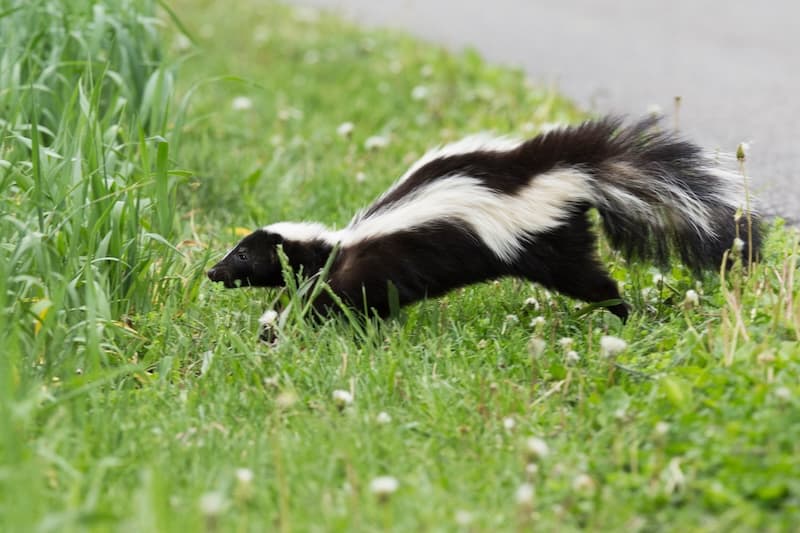
- Name: Skunk
- Category: Mammal
- Habitat: forests, grasslands, suburban areas
- Diet: Skunks are omnivore, with the ability to survive on variety wild vegetation, fruits and small animals, reptiles and insects, and water. It is not unusual for them to be out in the day looking for food.
- Reproduction: Striped Skunks in Ontario are born in May and early June, and average about 6-7 to a litter, can be 16! Their stripes can be full body length or a horseshoe shape. They also have a nose stripe which varies from ‘toothpicks’ to a ‘U’. Their home is a dark den underground or in under a shed, or porch.
About Skunk
Skunks do not see well past three feet. Sudden movements and noises will scare them. Move slowly in ultra-slow motions if the tail is and speak calmly. If they are going to spray, they go ‘into the position’ which is an awkward U shape. They look at you to aim and their butt faces you at the same time to fire. A skunk can’t climb, has no depth perception, and will fall into window wells, holes, even inground pools and will require help to get out.
More Information About Skunk
Skunk Spray on the dog or you
- ¼ C Baking Soda
- 1 teaspoon dishwashing detergent
- 1quart Hydrogen Peroxide
- The detergent breaks down the oil in the spray and the peroxide brings it to the surface and the baking soda neutralizes the Thiols [odor].
Location
-
Name: Toronto Zoo
Address: 2000 Meadowvale Rd, Toronto ON
-
Name: Algonquin Provincial Park
Address: Highway 60, Whitney ON
-
Name: Pukaskwa National Park
Address: Hwy 627, Heron Bay ON